


⚔️ “Hey, Bella! What kind of swords do you dance with and where did you get them?”
I answered this at length OVER HERE:

⚔️ “Any advice on sword dancing?”
YES.
⚔️ SWORD SAFETY
I highly advise against dancing with weapons that still possess a sharpened edge or point. I always beg my friends with machine- or hand- grinders to help me out so that I don't stab myself or cut off anything I need and like.
Seriously.
There are horror stories of dancers who have sliced off their fingers after dropping still-sharp weapons, and I personally know another dancer who has a scar on her thigh from not grinding off the point of her scimitar.
Also: Whether sharp or dull, Swords Are Weapons.
Be careful not to kill off the chandeliers in your restaurant, that patron (or waiter or spouse or child or pet) sneaking up behind you, the light fixtures in your home, the mirror or sprung wood floor in the studio you rent, or the expensive Swain mats of your dojo.
Swords are heavy. Belly dance swords are also not counterbalanced and weighted back toward the hand for martial movement. They’re weighted further out toward the center to make it easier to balance on the head or other silly belly dancer tricks.
⚔️ MARTIAL STYLE WIELDING
If you want to hack and slash and stab one of these swords martially, you really have to build up the physical conditioning to do so. Otherwise you risk injury.
That means strength, dexterity and flexibility in the hand, wrist, forearm, elbow, upper arm, shoulder, neck, back, core, and yes, gluts & legs.
You risk injury anyway because it’s a prop that is not designed for this.
Even martial arts practice weapons and the real things themselves risk injury—repetitive injury, clonking yourself in the noggin, whacking yourself in the ankle bone, BOOF—breaking your own nose, DOH—dropping it on your foot, MMMPH—getting too happy with yourself and swinging something around in a way that is too heavy for you. The list goes on.
Be aware of that.
Wielding a sword in this way also should come from your grounding, and from the strength and power of your legs, gluts, and core. NOT from your arms. I mean, unless you’re blessed enough to be like one of my beefy martial brothers with glorious upper-body strength that my frame will never have no matter how much weight lifting I do.
My body is built differently. Its warhorse power is in the flanks. giving a big ole dually-slap to mah buttcheeks. That means, to fling one of these unwieldy, monkey-trick-balanced swords around in a martial manner, I have to power it from my lower body and continue the momentum with the aerodynamic curve of the weapon.
Sabers were originally built to let a literal warhorse provide all the power, while the flimsy human guides it into the target. (Read: into the killing, maiming, gory, brutal, decapitating, eviscerating, limb-severing tool of war that it is.)
Keeping that in mind—that your lower body is the warhorse, and your upper body is the guide—use the trajectory and momentum. Don’t fight it.
Not even to halt the momentum. Redirecting the swing into your free hand will be far more graceful, expend less energy, and prevent injury than trying to halt the sword in action and make it do something else.
Again—unless you’re blessed with upper-body beef. Then have at and show off. I will envy you and drool.
I will also lovingly flip you the bird in the back of my mind out of jealousy.
Then I will go back to using leverage, lower-body power, trajectory, and momentum for all my death-defying sword-nanigans.
⚔️ SWORD BALANCING
Swords may be strong and fierce, but they are delicate. If you drop one, you may have to readjust its balance.
Okay, it’s when. You’re gonna drop the thing. It sucks, but there it is.
Do your utmost to prevent this.
Treat this sword like it’s your baby.
If you want to balance it on your head, start with a book to build up the isolation and the muscles to keep your head level. Progress to the scabbard or a cane because it's much lighter and will actually be harder to keep balanced.
If you have baby-fine, slippery hair like mine and don't want to wear a head covering, ratting and hair-spraying the hair on your crown helps.
So does beeswax—although be aware that beeswax melts with heat—i.e. stage lights, body heat, etc. Beeswax, when melted, becomes slippery.
If you balance the sword on bare skin, especially sweaty places at the top of the body like chin or forehead, I recommend doing those early in the performance so as not to coat the balance edge with sweat and/or melt your beeswax.
Constantly work to elongate the neck while you have the sword on your head, and especially if you're in a cranked-back position like balancing on the chin. Make LOTTTTS of space between the vertebrae.
Think thrice about doing this if you have neck injuries.
In fact, think thrice about putting the sword anywhere on your head if you have neck injuries.
There are a boatload of places you can balance the sword(s) beside the classic on top of the head: forehead, chin, chest, shoulder, palm of the hand or the fancier fingertip(s), forearm, back, belly (makes for silly belly dancer tricks while doing flutters and belly rolls), thigh or knee, ankle, top of the foot, between toes. I’ve also seen dancers balance one blade cross-ways on top of another.
Obviously some of these are best done while you’re on the ground.
Remember level changes in general—it’s dramatic during balancing sections, and it gives you access to creative uses of the sword.
Change up the way you balance: stationary while doing intricate isolations, stationary while doing softer gushy moves, traveling, spinning, performing acrobatic feats of bold, daring badassery.
Be creative. Continually ask yourself: how can I use this prop in a way I’ve never seen it used before?
Heck, sometimes I don’t put the sword on my head at all in a dance. It’s not only to be contrary to the norm. It’s not only to challenge myself to do something else.
Sometimes it’s because I have a story to tell.
For example, the tale of the zipper-mouthed Nice Girl…the Recovering Doormat…the survivor of violation and abuse who learns martial arts.1 The story of how hard it was to even pick up that sword, much less learn to wield it. And the acknowledgement of the great weight that a martial artist carries on her head once everything in her hands is transformed into a weapon.
That weight brought me to my knees.
It should.
Learning to wield The Sword with respect and honor is a grave responsibility.2
That topic is rightfully contemplated on one’s knees with one’s head deeply and humbly bowed.
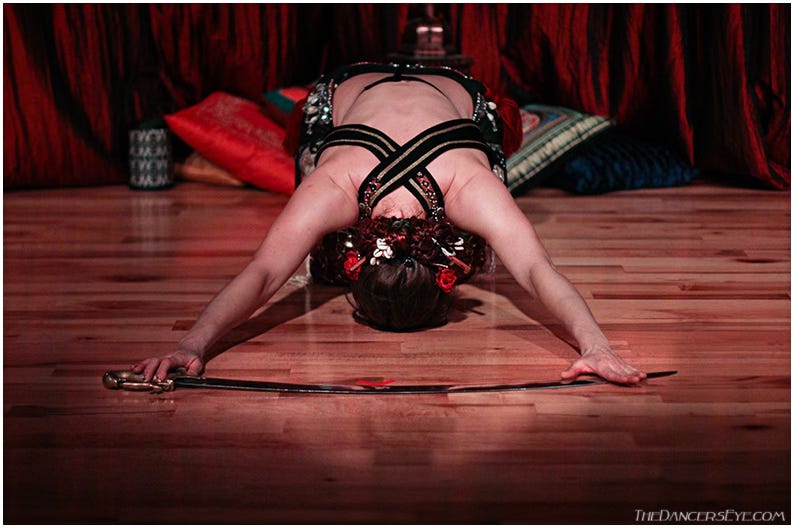
Totally a different way of being down there than what brought me to martial arts in the first place.
Of course, learning to stand back up and straighten one’s spine after being taken out at the knees, bowed and bound with one’s hands behind one’s back, and choke-chained into silence is a monumental triumph. It deserves exuberant celebration.
Plus…you know…dancing with hefty, shiny objects is a whole lot of fun.
⚔️ SO MUCH MORE THAN CIRCUS-MONKEY TRICKS
Intentionally make the transitions into, out of, and between balance positions an engaging part of the dance.
Take your time, and intersperse the balance tricks with…um…dancing?
If your dance is just a clunky show-off from one balance point to the next as you plop the sword onto your body and then thunk it down somewhere else, you’re missing 3/4 of this dance form’s artistry.
The sword can be held and wielded ceremonially.
Used as a frame to your body’s movements.
Placed on the floor and danced around or touched or acknowledged symbolically.
Placed on the floor and ignored for a pure dance section.
Placed on the body and forgotten about as you show off — look, ma! No hands! See? I can do all this groovy stuff with a sword on my head! (I mean, yes. Sword dance is also about the fun, badass circus monkey tricks.)
Wielded artistically.
Wielded martially.
These two are not mutually exclusive.
Use symbolism, as well as the key transitions, swells, ebbs, and breathing moments in the music.
Let the music do the work for you—choose your various themes (stationary, traveling, wielding, monkey tricks) according to the themes in the music.
That intense part of the music when it’s mostly mysterious drums? Stalk your prey.
Or place the sword on the ground and pay it homage with your bow.
Or ceremonially place the sword on your head like you’re gearing up for the most intense feat of badassery anybody has ever seen.
(Your face and the way you look at the audience will warn and prepare them for this.)
(It will also distract from the fact that you’re having trouble getting the friggin’ sword into the sweet spot.)
(Ahem.)
(Not speaking from experience at all here. Anywaaaay…)
That sweeping chorus that repeats three times? Choose three different spinning theories whenever you hear it.
That explosive special section before the final verse? Decapitate air! Eviscerate it. Skewer it. Rend every one of its limbs the fuck OFF—RAWR!— before licking your claws clean with a nice, intricate, self-satisfied (okay, fine, smug) balancing section when the much more sedate verse comes back on.
Seriously. If you choose wisely in your Muse-ic, and if you surrender to it like a good dancer-marionette, it will do most of the work for you. That leaves you free to do the work of all the sword badassery.
© 2026 Hartebeast
You can find the tales of my Damsel To Dangerous journey on my NSFW memoir blog, Bella & the Beast. This Section is dedicated specifically to SEX, LOVE & SELF-DEFENSE. A taste:

The weight of a martial artist’s responsibility: LEAP OF DEATH - where a recovering Nice Girl learns her first killing technique in karate. There may have been tears that day. Good. This subject is worthy of tears.
 | A guest post by
|